01
Document your business processes
Record each process: what it does, who owns it, and how critical it is to operations. Start with 5–10 core processes rather than trying to map everything at once.
Most GRC programs are organised around frameworks and controls. Kordon anchors yours to the business processes that actually matter — connecting every asset, vendor, and risk to the operations they support.
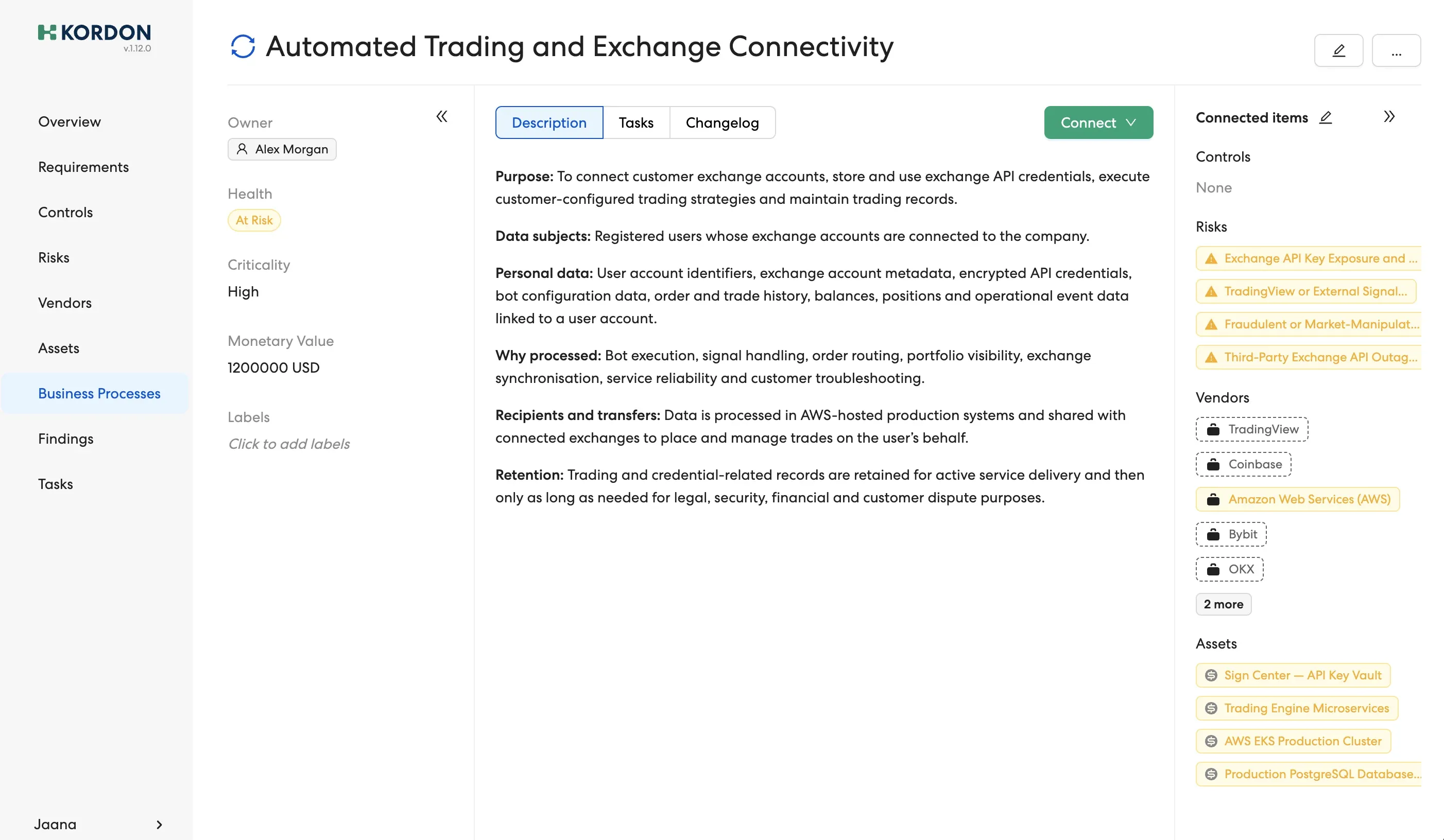
Start with your most critical processes and build out from there. Even a basic connected model gives you more operational clarity than a complete but disconnected inventory.
Record each process: what it does, who owns it, and how critical it is to operations. Start with 5–10 core processes rather than trying to map everything at once.
Link each process to the assets and vendors it depends on. This is where invisible dependencies become visible and concentration risks surface for the first time.
Connect the risks that could disrupt each process. Risk prioritisation now reflects what would actually stop the business, not just what scores highest on a technical severity scale.
Kordon tracks the health of each process continuously. When something changes anywhere in the chain — a control fails, a vendor lapses, or a finding opens — the affected processes reflect it immediately.
Business processes are the missing link between compliance documentation and operational reality. Kordon makes that link explicit and keeps it live.
Connect each business process to the assets and vendors it depends on. Reveal exactly what needs to be healthy for a process to run, and turn a flat inventory into an operational model.
Health cascades automatically from assets and vendors up to the process level. An expiring vendor contract, a failing control, or an unresolved finding flags the affected process immediately — without manual chasing.
Discover where multiple critical processes share the same asset or vendor dependency. These hidden single points of failure are invisible in a spreadsheet. They surface immediately when your processes are connected.
Connect risks directly to the processes they threaten. Prioritising security work becomes straightforward when severity reflects operational disruption, not just technical exposure.
Assign each process to the person accountable for it. Process owners stay informed about health status, get assigned tasks, and participate in the program without needing to understand GRC concepts.
Add custom fields, labels, and integrations to capture exactly what matters for your processes. Kordon adapts to your operational model, not the other way around.