01
Capture the controls you actually use
Start with your current controls or adapt Kordon's proven templates so the register reflects how your organisation really operates.
Control management in Kordon turns policies and requirements into live, owned security controls. Connect every control to the risks it mitigates, the frameworks it satisfies, and the recurring work that keeps it effective.
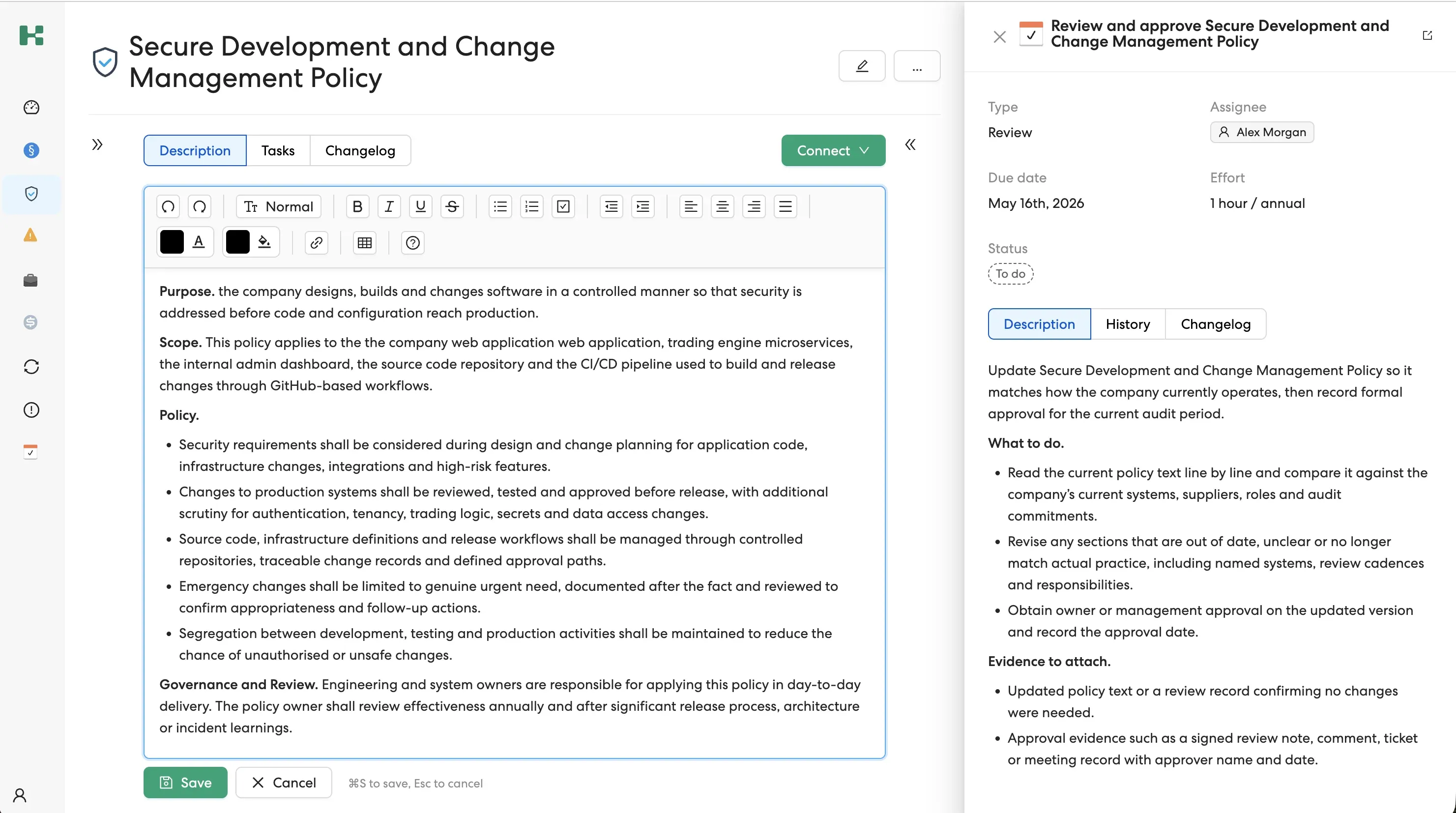
Kordon makes control management as easy to use as a spreadsheet but built for real ISMS work. Start with your existing controls or proven templates, connect them, assign recurring tasks, and keep evidence flowing. How audit tasks keep control status live →
Start with your current controls or adapt Kordon's proven templates so the register reflects how your organisation really operates.
Link controls to framework requirements, risks, assets, vendors, and business processes so each control has a clear purpose.
Create maintenance, review, and audit tasks with clear owners, due dates, and evidence expectations.
As tasks are completed and audits pass or fail, Kordon updates control status and shows the real downstream impact on risks, assets, business processes and oversight.
Controls are the heart of any ISMS. Kordon helps you move beyond a folder of documents and see which controls are operational, who owns them, and how they reduce real risk.
Use controls as the operational layer that connects policy intent to real security work across your organisation.
Link each control to the risks it mitigates, the requirements it satisfies, the assets it protects, the vendors it governs, and the findings it responds to.
See at a glance which controls are implemented, failing, or drifting because of overdue tasks, failed audits, or missing follow-up.
Keep a clear control register with owners, implementation notes, evidence expectations, and connected context in one place.
Assign recurring maintenance, review, and audit tasks to the people who actually keep each control working.
Extend control operations with Kordon's API and official n8n node to sync systems and automate recurring workflows. How GRC engineering works in Kordon →