What is audit management software?
Audit management software helps organisations plan, schedule, execute, and document audits — and track findings through to remediation. For information security teams, this means managing the internal audits required by ISO 27001 (Clause 9.2), SOC 2, and NIS2: scheduling recurring control tests, collecting and linking evidence, recording nonconformities, and maintaining a clear audit trail for certification auditors. In Kordon, audit management is built into the same platform as your controls, risks, and tasks — not a separate tool that needs to stay in sync with your ISMS.
How is Kordon different from enterprise internal audit software?
Enterprise internal audit tools like AuditBoard, TeamMate+, and Workiva are designed for Chief Audit Executives running dedicated internal audit teams — typically auditing financial controls, operational processes, and SOX compliance. They manage the audit as a standalone workflow, separate from the controls and risks those audits are actually testing. Kordon is purpose-built for information security audit management: the security manager running their own ISO 27001 or SOC 2 internal audit program as part of a broader ISMS role. In Kordon, an audit task lives on the control it tests, an audit failure immediately updates that control's status, and findings stay connected to the risk and requirement they map to. The audit program and the ISMS run as one system — not two systems you have to keep in sync.
Does ISO 27001 require internal audits, and how does Kordon support them?
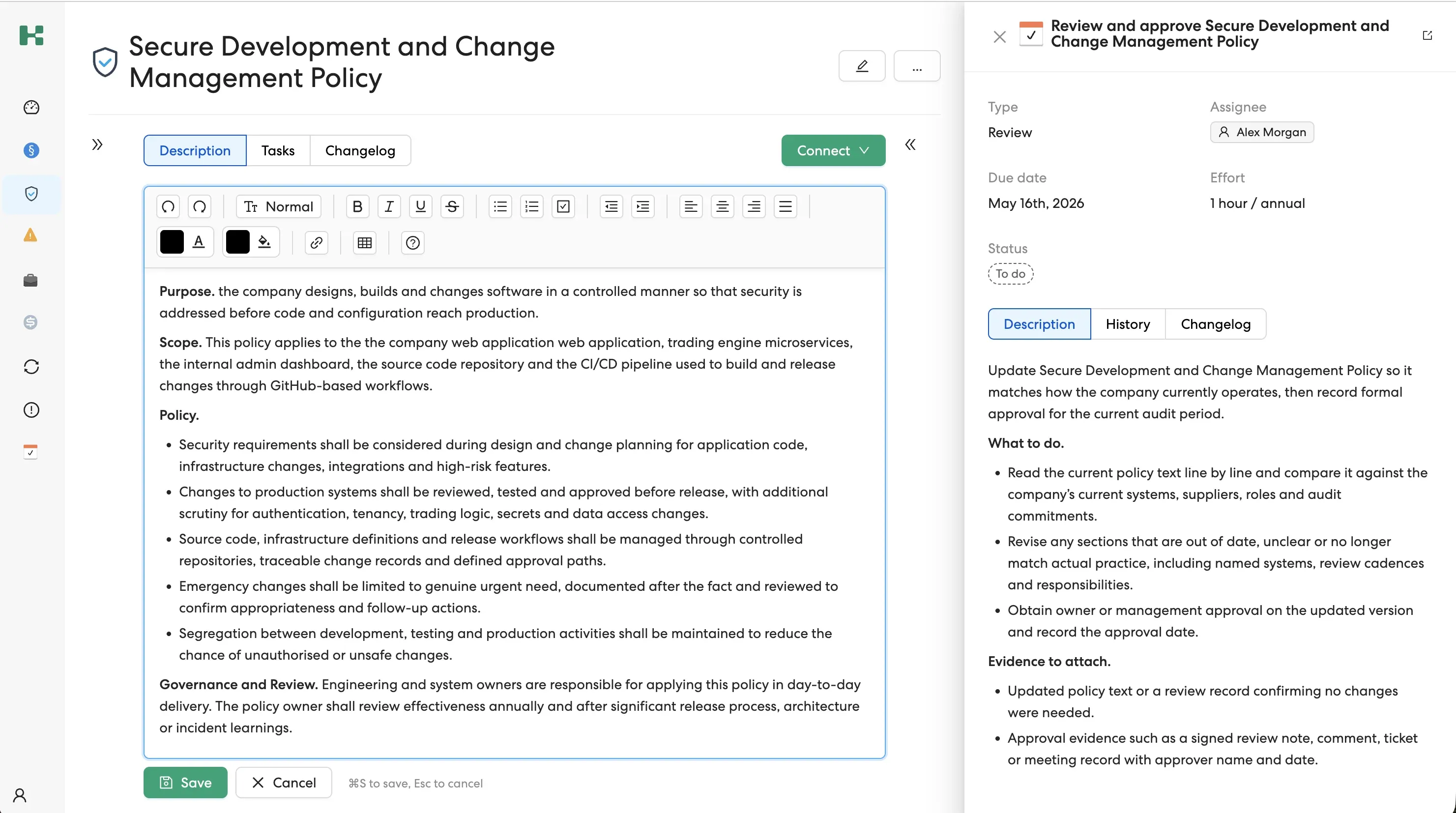
Yes. ISO 27001 Clause 9.2 requires organisations to conduct internal audits at planned intervals to determine whether the ISMS conforms to requirements and is being effectively implemented and maintained. In Kordon, internal audits are modelled as Audit-type tasks on controls. When an audit task is completed with a "Not OK" verdict, the control moves to Failing status and connected risks update immediately. Evidence from completed audit tasks stays attached to the control — so when your certification auditor reviews the audit record, the full trail is already there.
How much does audit preparation time reduce when using Kordon?
Kordon customers report reducing audit preparation time by up to 80% compared to spreadsheet-based audit management. The primary reason is continuous evidence accumulation: evidence is captured when tasks are completed throughout the year — attached directly to the tasks that generated it — so there is no manual evidence-gathering phase before the audit. Audit preparation becomes reviewing what is there, not assembling it from emails, shared drives, and faded memory.
Can external auditors access Kordon directly?
Yes. Kordon supports read-only auditor access, which allows your ISO 27001 certification auditor, external reviewer, or internal audit function to browse controls, view completed tasks and their evidence, check risk connections, and navigate the program's structure — without a full user account. This eliminates the need to compile an audit evidence pack or manage an email exchange of attachments. The auditor sees the program in the same system that runs it.
Is Kordon available as an on-premises deployment for audit-sensitive environments?
Yes. Kordon can be deployed on-premises inside your own infrastructure when internal hosting policy, data boundary requirements, or regulatory constraints mean that audit data and security program information cannot be sent to a vendor-hosted cloud environment. On-premises deployment gives you the same connected audit model — tasks, evidence, findings, control status — running entirely within the environment you control. Most GRC platforms are SaaS-only; on-premises is a Kordon differentiator for organisations in regulated sectors.
On-premises GRC platform →